
The profession of architecture stands as a unique fusion of art, science, and business, tasked with the profound responsibility of shaping the physical world around us. For those embarking on this demanding career path or seasoned professionals considering an international move, understanding the financial landscape is crucial. Architect salaries are not dictated by a single global standard but are instead a complex tapestry woven from factors like economic strength, cost of living, government investment, cultural value placed on design, and individual expertise. This in-depth analysis delves into the intricate world of architect salary trends across the globe, providing a clear picture of earning potential from North America to Asia-Pacific and Europe.
A. Decoding the Variables That Shape an Architect’s Paycheck
Before we examine country-specific data, it is essential to understand the multitude of factors that influence an architect’s earning power. These variables explain why two architects with identical job titles can have vastly different compensation packages.
A. Experience and Seniority: This is the most significant determinant. Salaries typically progress through distinct tiers:
-
Junior/Entry-Level Architect (0-3 years): Focused on learning, drafting, and supporting senior staff under supervision.
-
Mid-Level Architect/Designer (4-9 years): Takes on more project management, client interaction, and design development responsibilities; often pursuing or having obtained licensure.
-
Senior Architect/Project Manager (10-15 years): Leads projects, manages teams and budgets, and serves as a primary client contact.
-
Associate/Principal/Partner (15+ years): Involved in firm leadership, business development, strategic planning, and has ownership stakes.
B. Geographic Location: Within a single country, salaries can fluctuate dramatically between major metropolitan hubs and rural areas. Cities with high costs of living (e.g., New York, London, Tokyo, Zurich) typically offer higher salaries to compensate, though the adjustment is not always proportional.
C. Specialization and Niche Expertise: Generalists are valuable, but specialists often command premium salaries. High-demand niches include:
-
Sustainable/Green Design (LEED, BREEAM, WELL AP): Expertise in energy efficiency and environmental design.
-
Urban Planning and Design: Focusing on the macro-scale design of cities and communities.
-
Healthcare Architecture: Designing complex medical facilities requiring specific regulatory knowledge.
-
Data Center/BIM Management: Technical expertise in Building Information Modeling is increasingly critical and well-compensated.
-
Restoration and Conservation: Working on historical buildings and heritage sites.
D. Type of Employer: The sector an architect works in directly impacts salary ranges.
-
Large Corporate Firms: Often offer higher base salaries, structured bonuses, and better benefits but may involve less design autonomy.
-
Small-to-Medium (SME) Studios: May offer lower base pay but greater creative control, project diversity, and potential for profit-sharing.
-
Government/Public Sector: Offers high job security, excellent benefits, and stable hours, though salaries may be lower than in the private sector.
-
Self-Employment/Private Practice: Carries the highest income potential but also the greatest financial risk and responsibility of running a business.
E. Economic Health and Construction Sector Growth: Architects are highly susceptible to economic cycles. A booming economy with significant real estate development and construction activity drives demand and salaries upward. Conversely, during recessions, construction is often one of the first sectors to contract, leading to job losses and salary stagnation.
F. Professional Licensure and Certification: In most countries, holding an official license to practice architecture (e.g., licensed by the AIA in the U.S., ARB in the UK) is a non-negotiable requirement for certain responsibilities and is a major catalyst for a significant salary increase. Additional certifications like LEED AP or PMP (Project Management Professional) further enhance earning potential.
B. Architect Salary Breakdown by Global Region
The following data provides a general overview of average annual salaries for mid-career architects. It is critical to remember these are estimates; actual figures vary based on the factors listed above. Salaries are presented in USD for comparative purposes but are often earned in local currency.
1. North America: The High-Stakes, High-Reward Market
-
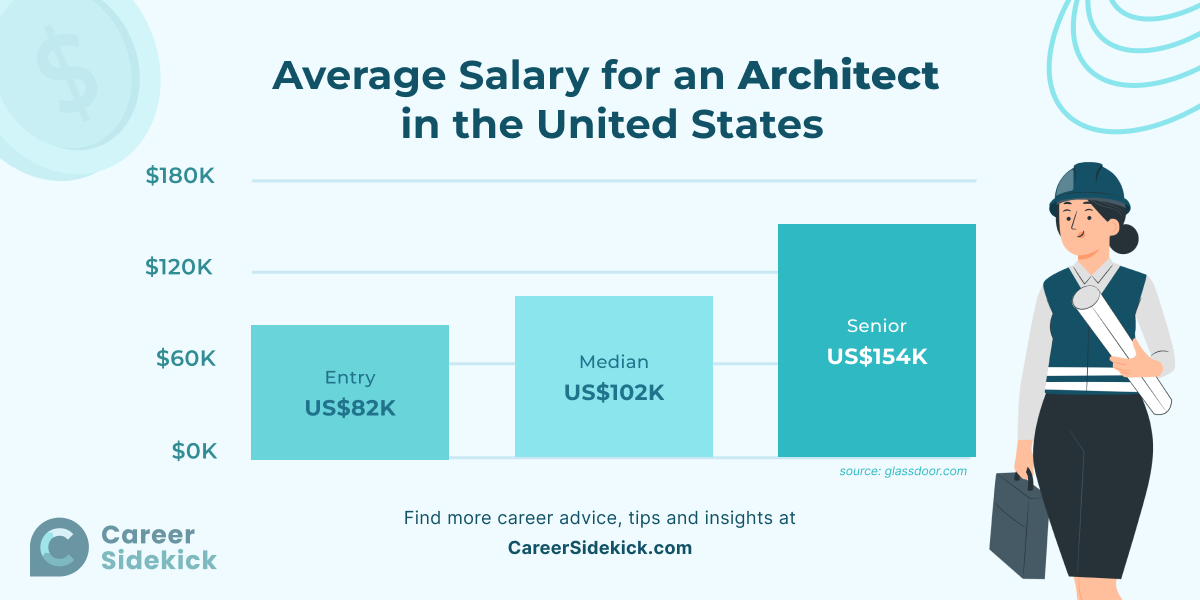
United States: The U.S. boasts one of the highest average architect salaries globally, but with immense internal variation.
-
National Average: Approximately $85,000 – $95,000.
-
High-Cost Cities: In cities like New York, San Francisco, and Los Angeles, senior architects and principals can easily earn $120,000 – $150,000+.
-
Key Influencers: Licensure (NCARB certification) is the single biggest differentiator. The health of the commercial and residential real estate markets is a constant driver. Specialization in tech (e.g., designing for Silicon Valley firms) or healthcare is highly lucrative.
-
-
Canada: The Canadian market is robust, with salaries slightly lower on average than the U.S. but paired with a strong social safety net.
-
National Average: Approximately $70,000 – $85,000 CAD (~$55,000 – $65,000 USD).
-
Hotspots: Toronto and Vancouver are the primary centers for architectural innovation and higher wages, though the cost of living, especially housing, is a major consideration.
-
2. Europe: A Tapestry of Variation from West to East
Europe presents a diverse picture, with Western European nations offering strong compensation aligned with high living costs, while Eastern Europe shows promising growth from a lower base.
-
United Kingdom: The UK market is dynamic, centered overwhelmingly on London.
-
National Average: Approximately £40,000 – £55,000 (~$50,000 – $70,000 USD).
-
London Premium: Salaries in the capital are typically 20-30% higher than the national average. RIBA (Royal Institute of British Architects) membership and ARB registration are critical for career advancement.
-
-
Switzerland: Consistently ranks as the highest-paying country in Europe, reflecting its incredibly high cost of living.
-
Average Salary: CHF 90,000 – CHF 120,000 (~$100,000 – $135,000 USD). Mastery of German, French, or Italian is often required.
-
-
Germany: Europe’s economic powerhouse has a strong and stable demand for architects, particularly in sustainable design and urban redevelopment.
-
Average Salary: €50,000 – €65,000 (~$55,000 – $72,000 USD). Cities like Berlin, Munich, and Frankfurt are the main employment hubs.
-
-
Western Europe (France, Netherlands, Spain): These markets offer a good work-life balance with respectable salaries.
-
France/Netherlands: Average around €45,000 – €60,000 (~$50,000 – $66,000 USD).
-
Spain/Italy: Salaries are lower, averaging €30,000 – €45,000 (~$33,000 – $50,000 USD), reflecting higher unemployment rates and a different economic context.
-
3. Asia-Pacific: Rapid Growth and Expanding Opportunities
This region is the epicenter of global construction and urban development, creating massive demand for architectural talent.
-
Australia: Offers a strong balance of high compensation and quality of life.
-
Average Salary: AUD 80,000 – AUD 110,000 (~$55,000 – $75,000 USD). Major cities like Sydney and Melbourne drive demand, with a significant focus on sustainable and coastal-resilient design.
-
-
United Arab Emirates (Dubai/Abu Dhabi): A hub for iconic, large-scale projects and tax-free salaries, which has historically attracted global talent.
-
Average Salary: AED 180,000 – AED 300,000 (~$49,000 – $82,000 USD). While tax-free, the cost of living can be high, and contracts are often package-based including housing and flights.
-
-
Singapore: A regional leader in innovative urban design and green building.
-
Average Salary: SGD 70,000 – SGD 100,000 (~$52,000 – $75,000 USD). The market is highly competitive and demands excellence.
-
-
China: The scale of development in China is unmatched, offering vast opportunities, particularly in megacity projects.
-
Average Salary: Highly variable but can range from ¥200,000 – ¥500,000+ (~$30,000 – $75,000+ USD) for experienced, often foreign, architects working on international projects.
-
4. Emerging Markets: Latin America and Africa
-
Brazil & Mexico: The largest markets in Latin America. Salaries are lower than in developed nations but offer growth potential. Average salaries range from $20,000 – $40,000 USD, highly dependent on the local economic climate.
-
South Africa & Nigeria: The most developed architectural markets in Africa. Salaries can be competitive for top firms and specialists, but the range is wide. Average often falls between $20,000 – $50,000 USD.
C. Beyond the Base Salary: Understanding Total Compensation
A comprehensive view of an architect’s earnings must look beyond the base salary. Total compensation includes:
-
Bonuses: Performance-based, project-based, or annual profit-sharing bonuses can add 5-15% to total income.
-
Benefits: Health insurance, retirement contributions (401k in the U.S., pension schemes in the UK), and paid time off are significant components of a package.
-
Professional Development: Support for continuing education, conference attendance, and exam fees.
-
Flexibility: The value of remote work options, flexible hours, and compressed workweeks is increasingly part of the compensation conversation.
D. Future-Proofing Your Architectural Career for Maximum Earnings
The field of architecture is evolving. To ensure long-term financial success, professionals must adapt.
-
Embrace Technology: Proficiency in advanced software (especially BIM like Revit), computational design, and even virtual reality (VR) for client presentations is no longer a bonus it’s a requirement for high-value roles.
-
Become a Specialist: Develop deep expertise in a high-growth area like sustainability, resilience design (for climate change), or healthcare.
-
Develop Business Acumen: Architects who understand project financing, business development, and client management are the ones who ascend to leadership and partnership roles.
-
Consider Global Mobility: Gaining experience in a different market, especially a high-growth one, can dramatically accelerate career and salary progression.
-
Network Relentlessly: Building a strong professional network through organizations like the AIA, RIBA, or CTBUH (Council on Tall Buildings and Urban Habitat) leads to opportunities that are never advertised.
E. Conclusion: A Global Profession with Localized Value
There is no one-size-fits-all answer to the question, “How much does an architect make?” The profession offers a wide spectrum of financial rewards, deeply intertwined with geography, economic conditions, and individual career choices. While countries like Switzerland, the United States, and Australia currently lead in pure compensation, emerging markets offer unique growth experiences.
The most successful architects financially and professionally are those who combine design talent with strategic career planning. They pursue licensure, cultivate in-demand specializations, embrace new technologies, and understand the business of design. By doing so, they not only enhance their own earning potential but also elevate the value of the architecture profession in shaping a better, more sustainable, and beautifully constructed world for everyone